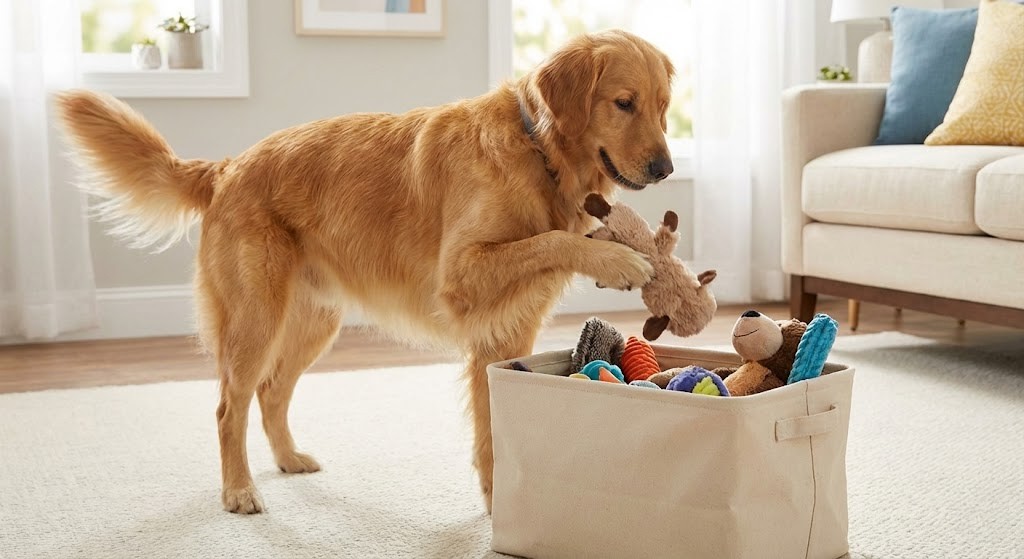
Imagine a living room where you don’t trip over squeaky hedgehogs and rope bones. Now, imagine your dog is the one cleaning them up.
While it looks like a cute parlor trick to show off to friends, teaching your dog to “Tidy Up” is actually a sophisticated mental workout. It engages your dog’s problem-solving skills, builds impulse control, and burns more energy in 15 minutes than a 3-mile walk.
This guide uses the Back-Chaining Method—the gold standard in behavioral science—to teach your dog to put toys away without frustration or force.
1. The Setup: Setting Your Dog Up for Success
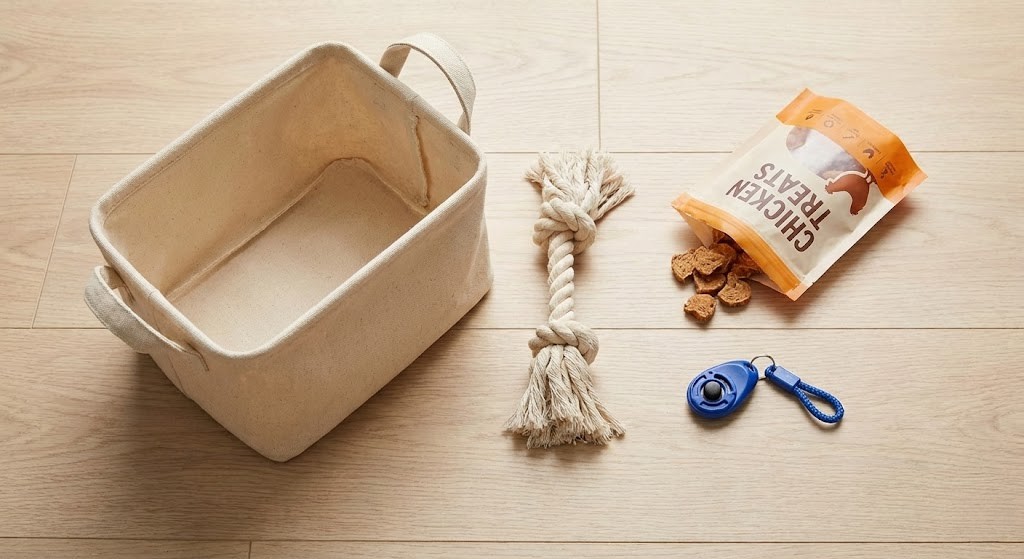
Before you start, you need to manage the environment. A common reason dogs fail at this trick is not a lack of intelligence, but “environmental feedback” (usually noise).
The Equipment
- The “Quiet” Box: Avoid tall, hard plastic bins. The loud CLUNK of a toy hitting the bottom can startle a dog, creating a fear of the box.
- Best choice: A canvas storage cube, a shallow cardboard box, or a basket lined with a yoga mat or towel.
- The “Goldilocks” Toy: Choose a toy your dog likes but isn’t obsessed with.
- Too boring: They won’t pick it up.
- Too high-value: They will refuse to drop it (resource guarding).
- Ideally: A plush toy or a dumbbell that is easy to hold.
- High-Value Treats: Real chicken, cheese, or freeze-dried liver. You are asking your dog to give up a possession; the “payment” must be worth it.
- A Clicker: This marks the exact moment the dog does the right thing.
2. The Golden Rule: Why We Use “Back Chaining”
Most people try to teach this forward: Pick up toy $\rightarrow$ Walk to box $\rightarrow$ Drop toy.
This usually fails. By the time the dog reaches the box, they are confused and far away from where they started.
Instead, we use Back Chaining. We teach the last step first.
- Drop (The Payday)
- Carry
- Fetch
By teaching the “Drop” first, the box becomes the “Hot Zone” where rewards happen. Your dog will eventually rush to put the toy in the box because that is the fastest way to get paid.
3. The Prerequisites
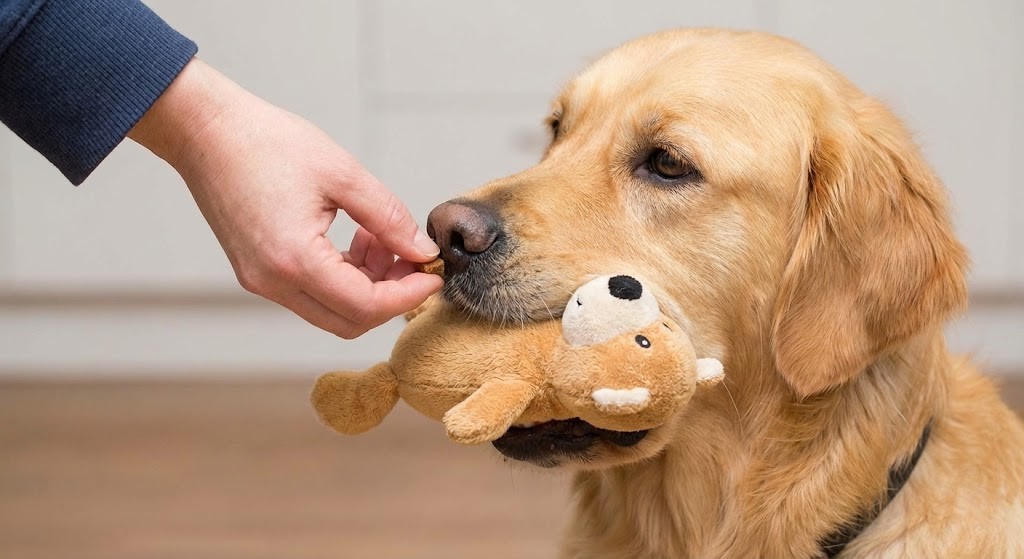
Don’t attempt the full “Tidy Up” until your dog understands these three basics:
- “Take It”: Willingness to grab an object.
- “Hold”: Holding the object for 1–2 seconds without spitting it out immediately.
- “Drop It”: Voluntarily opening their mouth.
Pro Tip: When teaching “Drop It,” use the Trade Game. Offer a treat right at their nose. When they open their mouth to eat, say “Drop It.” This teaches them that dropping the toy doesn’t mean the fun ends—it means a snack appears.
4. The Step-by-Step Protocol
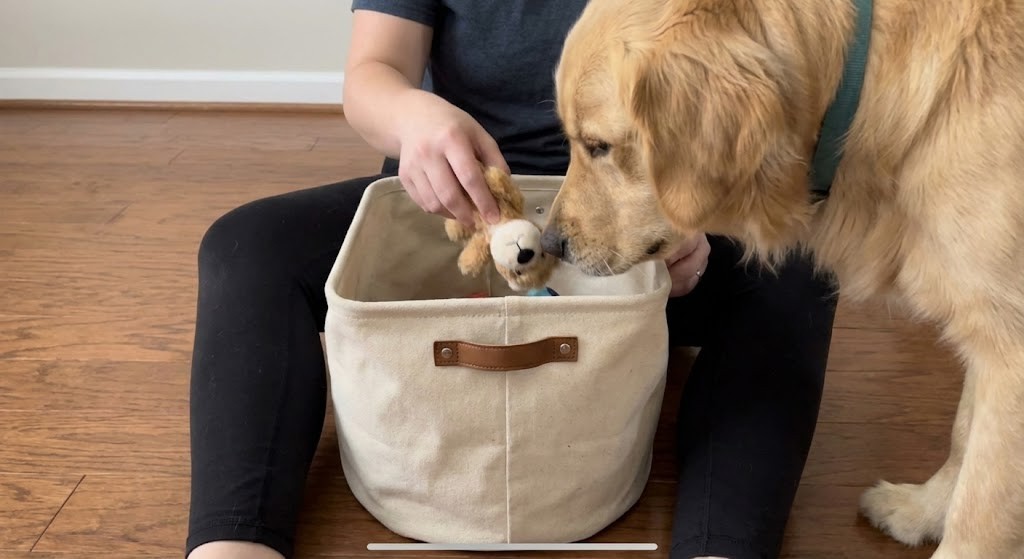
Phase 1: The “Kill Zone” (The Stationary Drop)
Sit on the floor with the box between your legs to create a funnel.
- Hold the toy directly over the opening of the box.
- Have your dog take the toy. Their head should already be over the box.
- Cue “Drop It.”
- CRITICAL TIMING: Click the instant their jaws open—not when the toy hits the bottom. You are marking the release, not gravity.
- Reward: Drop the treat inside the box. This makes the box magnetic.
- Repeat 20 times.
Phase 2: The “Inch-Worm” (Adding Distance)
Now that the dog knows “Open mouth over box = Treat,” we add movement.
- Hold the toy 6 inches outside the box.
- Let the dog take the toy.
- Lure their nose over the box with your hand.
- Wait for them to be over the “chasm” of the box.
- Cue “Drop It.” Click and treat.
- If they drop it outside the box: No click, no treat. Reset and try again. They must learn that accuracy matters.
Phase 3: The Short Retrieve
- Place the toy on the floor 1 foot away from the box.
- Cue “Take It.”
- Point to the box or tap the rim to encourage them to approach.
- When their head is over the box, cue “Drop It.”
- Party time! (Jackpot reward).
Phase 4: Adding the Cue
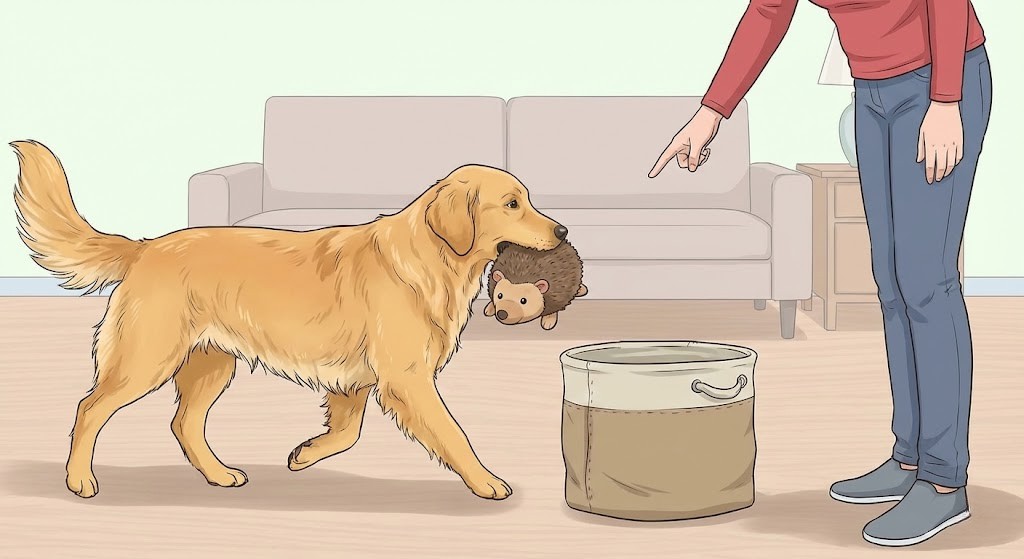
Once the dog is consistently picking up the toy and dumping it in the box, you can name the behavior. Say “Tidy Up” right as they pick up the toy. Eventually, you can say “Tidy Up” while pointing at a mess of toys.
5. Troubleshooting Common Issues
Even the smartest dogs run into snags. Here is how to fix them using behavioral science.
| Problem | The Cause | The Fix |
| The Flinger (Throws toy at you) | Dog is rushing to get the treat. | Feed Low. Deliver the treat inside the box, at the bottom. This draws their focus downward, not up at your face. |
| The Chewer (Lies down with toy) | Boredom or toy is too high-value. | Keep Moving. Back away as they pick up the toy to trigger their “follow” instinct. Keep sessions under 2 minutes. |
| The Scaredy-Cat (Afraid of noise) | The “thud” of the toy scares them. | Sound Dampening. Line the box with a thick towel. Practice dropping soft plushies before hard toys. |
6. Luring vs. Shaping: Which is Right for You?
There are two ways to guide your dog during Phase 2.
- Luring (Easiest): You use a treat to guide the dog’s nose over the box like a magnet. This is fast, but the dog is just following food, not thinking.
- Shaping (Advanced): You wait for the dog to look at the box, then Click. Then wait for them to step toward it, then Click. You reward “successive approximations.”
Which should you use?
Use Luring to get the initial idea across quickly. Switch to Shaping if you want to tire your dog out mentally, as they have to “solve the puzzle” themselves.
📅 7-Day “Tidy Up” Roadmap
3 Sessions Per Day • 5 Minutes Each
1-2
Building Value (The Kill Zone)
Goal: Dog learns the box is a magic treat portal.
- Hold toy directly over box opening.
- Cue “Drop It” → Click when jaws open.
- Must Reward: Drop treat inside the box.
3-4
The Inch-Worm (Movement)
Goal: Dog moves head over box before dropping.
- Hold toy 6 inches outside the box.
- Lure nose over the center of the box.
- Wait for alignment, then cue “Drop It.”
5
The Short Retrieve
Goal: Picking up from floor and delivering.
- Place toy on floor 1 foot away.
- Cue “Take It” → Tap box rim.
- Dog carries to box → Drop → Jackpot!
6
Adding The Name
Goal: Associating the word “Tidy Up.”
- Say “Tidy Up” exactly as they turn toward the box.
- Repeat 10-15 times per session.
- Test by pointing and saying the word first.
7
The Cleanup Challenge
Goal: Multiple toys back-to-back.
- Scatter 3 toys around the room.
- Point to Toy A → “Tidy Up” → Reward.
- Point to Toy B → “Tidy Up” → Reward.
- Toy C → “Tidy Up” → JACKPOT!
Final Thought
Teaching your dog to put toys away changes the dynamic of your relationship. You aren’t just commanding them; you are communicating a complex task. Be patient, keep sessions short, and if your dog gets frustrated, go back to Phase 1 and reinforce the “Drop.”
Happy Training! 🐾

Hi! I’m Muhammad Talha, the paw-sitive mind behind PoochHive.I’ve been a lifelong dog lover and pet enthusiast, dedicated to helping dog owners give their furry friends a happier, healthier life.On PoochHive, I share trusted tips, training guides, health advice, and product reviews — all based on research, experience, and a whole lot of love for dogs.